Do Online Pooja Bookings Actually Work? What No One Tells You
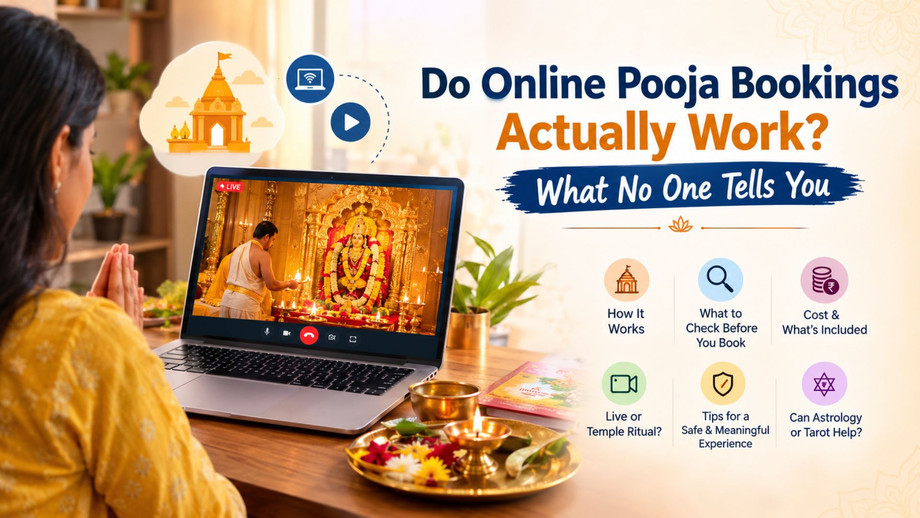
Do online pooja services actually work, or are they simply a convenient digital version of a traditional ritual? Online Pooja Booking can be a practical way to arrange a ceremony when distance, travel, work, or family commitments make physical attendance difficult. However, the quality of the experience depends less on the website and more on who performs the ritual, what is included, and how transparently the service operates. Modern providers may arrange temple-based rituals performed on a devotee's behalf or live ceremonies where participants join through video. Understanding that difference is essential before paying. A trustworthy service should clearly explain the ritual, priest or temple, timing, required devotee information, participation method, pricing, and cancellation terms.
What Does an Online Pooja Actually Involve?
An online religious service is not necessarily a recorded ceremony or a generic video. Depending on the provider, a real priest may perform the ritual at a temple or dedicated sacred space while using information supplied by the devotee for the sankalp.
Some services also allow devotees to participate through live video. Others perform the ritual on the devotee's behalf and provide photographs, video evidence, confirmation, or prasad afterward. Current service models show that there is no single standardized format.
What information may you need to provide?
A provider may request:
-
Devotee's full name
-
Gotra, when known or relevant
-
Date of birth or other ritual details
-
Preferred date and time
-
Purpose or intention of the ceremony
-
Contact and delivery information when applicable
A practical tip is to ask exactly why each requested detail is necessary. Avoid providing sensitive personal information that the service does not genuinely require.
Does remote participation change the experience?
Yes. A live video ceremony can offer direct participation and the opportunity to communicate with the priest. A temple-performed ritual on your behalf may provide convenience but less direct involvement.
Neither format should automatically be described as universally better. The appropriate option depends on the ritual, family tradition, personal expectations, and the provider's stated procedure.
How Can You Tell Whether a Pooja Service Is Trustworthy?
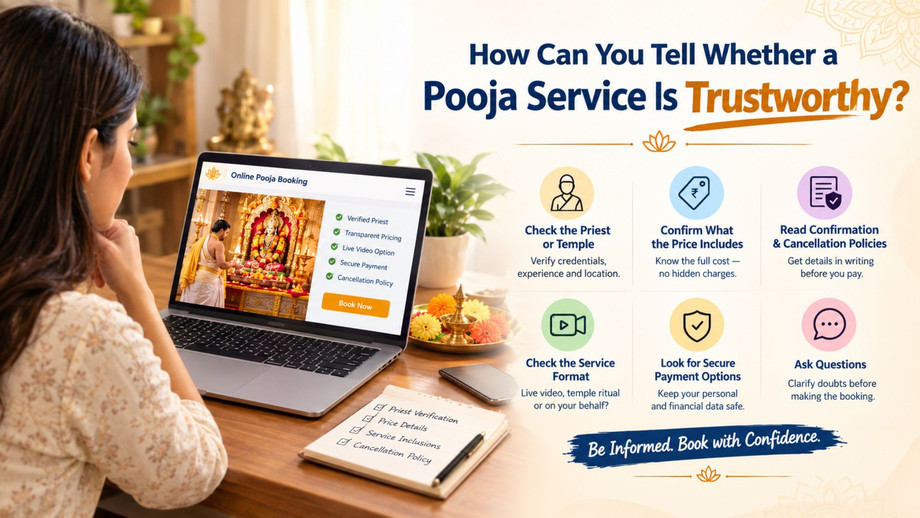
The biggest mistake is treating a polished website as proof of authenticity. A professional-looking booking page can make purchasing easy, but it does not independently establish the qualifications of a priest or the nature of a ceremony.
Look for verifiable information before making payment.
Check the priest or temple.
Reliable services should be willing to explain who performs the ritual and where it takes place. Some platforms publish priest profiles, expertise, languages, verification information, or the temple associated with a service.
Confirm what the price includes.
A low advertised price may exclude important extras. Ask whether the fee covers:
-
Priest services
-
Ritual materials or samagri
-
Temple charges
-
Live participation
-
Prasad or delivery
-
Taxes or platform fees
Recent online services demonstrate that pricing structures can differ substantially according to the ritual, priest requirements, materials, duration, and optional additions.
Look for confirmation and cancellation policies.
A useful operational standard is to receive written confirmation containing the selected ritual, date, time, payment details, and contact information. Cancellation and rescheduling rules should also be available before checkout.
Practical check: If a provider cannot clearly tell you what happens after payment, pause the transaction and ask questions before proceeding.
When Should You Consider Speaking With an Astrologer Before a Ritual?
Religious rituals and astrology can overlap in some traditions, but they are not automatically the same service. A devotee may seek an astrologer's perspective when the ritual is being considered alongside questions about timing, planetary interpretations, marriage, career, or other personal concerns.
A live chat or call with an Astrologer can provide a separate consultation where you discuss your questions directly, rather than assuming every pooja recommendation is automatically personalized.
What should an astrology consultation clarify?
A useful consultation should distinguish between:
-
Traditional astrological interpretation
-
Religious or devotional practices
-
Personal decision-making
-
Cultural or family customs
-
Claims that cannot be objectively guaranteed
For example, someone considering a ritual during a difficult period in their life may benefit from understanding why a particular practice was suggested, rather than being told it will produce a guaranteed result.
That distinction is important for trust. Astrology can be approached as a traditional interpretive system, but it should not be presented as a substitute for professional medical, financial, legal, or psychological advice.
How Do You Make Online Pooja Booking More Reliable?
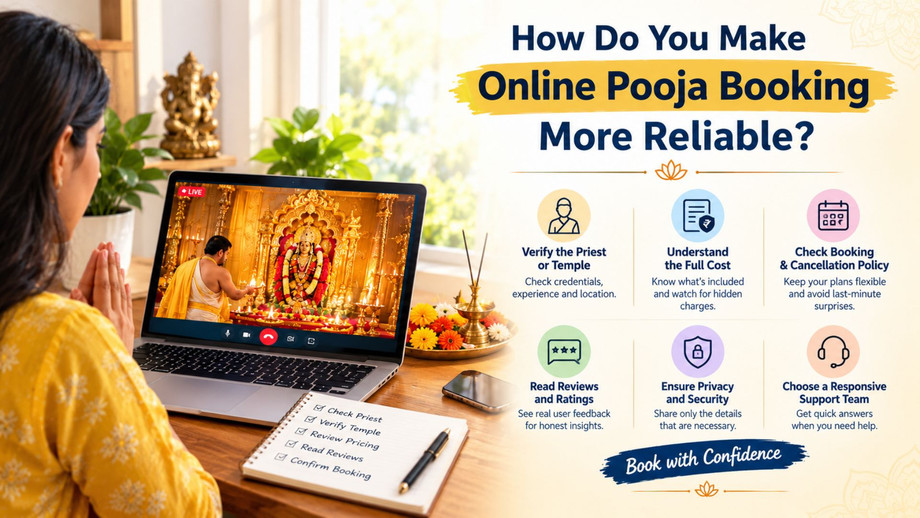
Online Pooja Booking becomes more dependable when the user evaluates the actual service rather than relying on promises about guaranteed outcomes.
A practical five-step approach is:
1. Define the ritual
Know what ceremony you want and why. If you are unsure, ask the provider to explain the purpose, procedure, and traditional context.
2. Verify the performer
Check whether the priest, temple, or organization is identifiable. Where available, review qualifications, experience, language support, and verification information.
3. Compare the complete cost
Do not compare headline prices alone. Include materials, delivery, participation, taxes, and other optional charges.
4. Confirm the ceremony format
Ask whether the ritual is performed live, at a temple on your behalf, or through another arrangement. Current services use all of these models.
5. Keep expectations realistic
A religious ceremony may have deep cultural or personal significance, but no responsible provider should guarantee a specific financial, health, relationship, or life outcome.
Can Tarot and Numerology Add Useful Context?
A Tarot and Numerology Reading is another type of spiritual consultation, but it should be kept conceptually separate from the ritual itself. Tarot uses symbolic cards for interpretation, while numerology traditionally examines numerical patterns associated with names, dates, or other systems.
These practices may appeal to people seeking reflection, personal meaning, or an alternative perspective. However, they should not be confused with evidence-based forecasting.
For a more responsible experience, ask the practitioner:
-
What system or method do you use?
-
How do you interpret uncertain results?
-
Are predictions presented as possibilities or guarantees?
-
Can I make my own decisions without pressure?
-
Are additional services being recommended for a genuine reason?
The strongest practical approach is to treat spiritual consultations as a source of reflection rather than a guaranteed mechanism for controlling future events.
What Are the Most Common Booking Mistakes?
Several avoidable mistakes repeatedly appear when people arrange religious services online.
Mistake 1: Choosing only by price.
A cheaper package may exclude materials, participation, or other services.
Mistake 2: Assuming every service is live.
Some ceremonies are performed at a temple on the devotee's behalf, while others involve live video participation.
Mistake 3: Ignoring cancellation rules.
A booking may become non-refundable after a certain point.
Mistake 4: Believing guaranteed-result claims.
Spiritual practices can carry religious and personal meaning, but specific life outcomes cannot responsibly be guaranteed.
Mistake 5: Sharing unnecessary information.
Provide only the personal details required for the stated ritual and service.
You can also watch: The Ultimate Zodiac Podcast Love, Compatibility & Astrology Secrets
Conclusion
Digital religious services can make traditional ceremonies easier to coordinate, particularly for people living far from family temples or managing demanding schedules. The key is to evaluate the ritual, priest or temple, participation method, total cost, privacy practices, and cancellation policy before paying. Convenience should simplify the process without replacing informed judgment or the personal meaning of devotion. If you are considering a remote ceremony, compare providers carefully, ask direct questions, and choose a service whose promises and procedures are clearly explained.
Frequently Asked Questions
Q: What is an online pooja and how does it work?
A: It is a digital way to arrange a religious ceremony with a priest, temple, or service provider. Depending on the service, the ritual may be performed at a temple on your behalf or conducted through live video. You generally select the ritual, provide required details, choose a date, pay, and receive confirmation.
Q: Is an online pooja the same as attending a temple in person?
A: No. An online arrangement may involve a priest performing the ritual on your behalf, while another service may let you participate through live video. Physical temple attendance provides direct presence and participation. Always confirm the ceremony format because providers use different models and inclusions.
Q: How should I book a pooja online for the first time?
A: Start by identifying the exact ritual you need. Then verify the priest or temple, review the procedure, check the date and timing, understand what the fee includes, read cancellation terms, and confirm how you will participate or receive evidence of completion. Pay only after the details are clear.
Q: How much does an online pooja usually cost?
A: There is no universal price. Cost can vary according to the ritual, priest requirements, temple, duration, materials, location, participation method, and optional services such as prasad delivery. Compare the complete package rather than choosing solely by the advertised starting price, and check for additional fees before payment.
Q: What is the best way to choose a reliable online pooja provider?
A: Choose a provider that clearly identifies the priest or temple, explains the ceremony, publishes pricing or package details, provides booking confirmation, protects personal information, and states cancellation policies. Verification details and transparent communication are useful indicators, but you should still independently assess whether the service matches your religious and practical requirements.
Q: What is the most common mistake people make when booking a pooja online?
A: The most common mistake is assuming every digital service provides the same experience. Some arrange temple rituals on your behalf, while others offer live participation. People also overlook extra charges or cancellation conditions. Read the complete service description and ask questions whenever the ceremony, price, timing, or deliverables are unclear.


.png)
Comments
Post a Comment